Introduction To Python 3.13
In the modern era of digitalisation, coding is turning out to be a requisite. Everything we see around us, whether it is mobile applications or websites, has been coded using artificial intelligence and games. Python is one of the most popular and easy-to-use programming languages in the world.
The most recent release is Python 3.13 as of December 2024 and it is still working on performance, ease and developer experience. Python 3.13 is also a superb starting point to launch the plan into programming among Class 9 students.
What is Python?
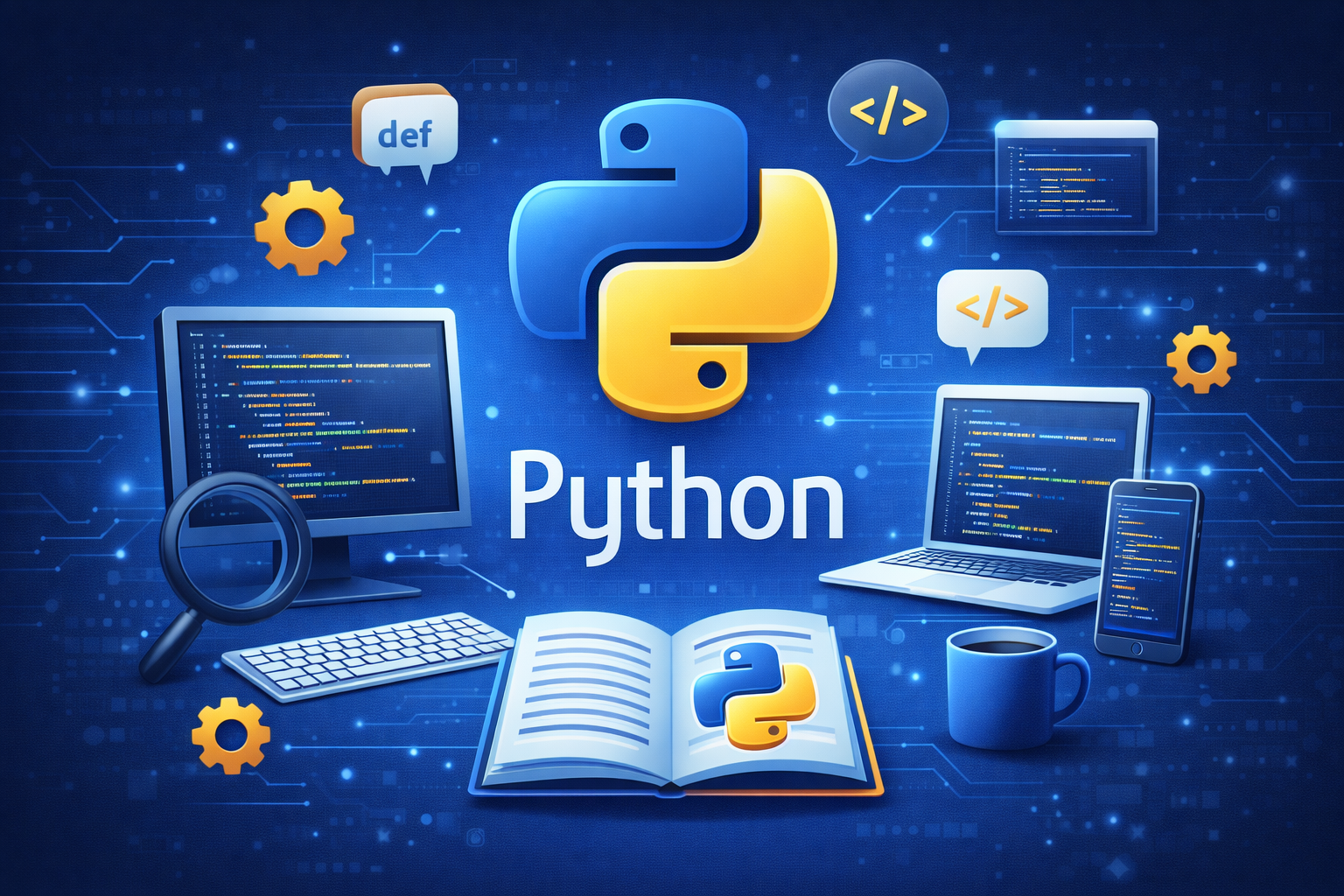
Python is a general-purpose high-level programming language. It is known for its
- Simple and readable syntax
- Easy-to-understand structure
- Powerful capabilities
- Wide range of applications
Python is written in nearly plain English, unlike most other programming languages. This is why it is perfect in the case of beginners who learn to program first of all.
Why Learn Python in Class 9?
Python helps students:
- Develop logical thinking
- Develop problem-solving skills.
- Learn programming in the real world.
- Get ready to do higher work in computer science.
Python is taught in many schools and universities as the main teaching language since it is simple to learn and powerful enough to be used at a professional level.
What is new in Python 3.13?
Python 3.13 focuses mainly on the following:
- Faster and better performance.
- Improved error messages to learners.
- Enhanced memory management
- Stability improvements
Although there will not be an instant change in internal performance, beginners will enjoy quicker performance and better feedback in case of errors.
Python has been continuing to develop without losing its main simplicity.
Simple Python Programming Structure
Such a basic Python program would appear as follows:
- print("Hello, World!")
- The text is displayed on the screen in this single line.
- The Python programs are written in files whose extension is '.py'.
The Python syntax has certain important features:
- There is no necessity of semicolons in lines.
- Space (indentation) is significant.
- Code is organised clearly
Key Concepts in Python
1. Variables
Data is stored in the form of variables.
Example:
name = "Arjun"
age = 14
In this case, two of the variables are name and age because they hold various kinds of data.
2. Data Types
Python allows a variety of data types:
int – whole numbers
float - decimal numbers
str - text
bool - True or False
Example:
marks = 89
percentage = 89.5
student = "Riya"
passed = True
3. Taking Input
Python is user-interactive.
name = input("Enter your name: ")
print("Welcome", name)
This is interactive in programs.
4. Conditional Statements
Python uses the decision-making tools of if, elif and else.
Example:
marks = 75
if marks >= 90:
print("Excellent.")
elif marks >= 50:
print("Passed")
else:
print("Try Again")
This assists in the development of rational programs.
5. Loops
Loops repeat actions.
For Loop:
for i in range(5):
print(i)
While Loop:
count = 1
while count <= 5:
print(count)
count += 1
Games, calculations and automation.
6. Functions
Functions are used to structure the code into reusable blocks.
def greet():
print("Good Morning")
greet()
Programs are organised and divided into functions.
7. Lists
Multi-values are various values contained in a single variable in lists.
marks = [85, 90, 78, 92]
print(marks[0])
The lists are helpful in holding sets of information.
Applications of Python
Python is applied in numerous real-life areas:
- Web development
- Game development
- Artificial Intelligence
- Data analysis
- Robotics
- Automation
- App development
Python is also used to create powerful systems even in major companies.
Advantages of Python 3.13 to Students
- Beginner-friendly syntax
- Quick testing and execution
- Large support community
- Extensive libraries
- Cross-platform compatibility
Students can produce small programs, mini-projects, and simple games as well as experiment with AI fundamentals.
Introduction to Good Programming Practices
Students of Class 9 are expected to practise the following:
- Coding in an understandable manner.
- Using proper indentation
- Assigning meaningful names to variables.
- Testing programs regularly
- Learning from errors
It is not about memorising commands, but it is about logic and step-by-step resolution that is called 'programming'.
Preparing for the Future
Studying Python in Class 9 prepares one with:
- Class 10 Computer Science
- Secondary level programming.
- Competitive coding
- Technological future careers.
Numerous other high-level languages and technologies are based on the identical logical principles taught in Python.
QUIZ FOR INTRODUCTION TO PYTHON 3.13
1. Python can be best characterised as either of the following?
A) A type of database software
B) A computer language that is used to write computer programs.
C) Computer operating system.
D) A web browser that is for internet browsing.
Answer: B) A computer language that is used to write computer programs.
2. Why is Python usually recommended to beginners who are first-time learners of programming?
A) It requires complex syntax
B) It uses very long commands
C) It is written in simple syntax and is easy to read.
D) It is only compatible with high-capacity computers.
Answer: C) It is written in simple syntax and is easy to read.
3. Python programs are normally saved with which file extension?
A) .exe
B) .py
C) .html
D) .doc
Answer: B) .py
4. Take a look at the line of Python code as follows:
print("Hello, World!")
So what is going to happen when this program executes?
A) The message Hello, World! will be shown on the screen through the program.
B) The program will terminate on error.
C) There will be nothing written on the screen.
D) The computer will restart
Answer: A) The message Hello, World! will be shown on the screen through the program.
5. How does one normally create a variable in Python?
A) int age = 14
B) age = 14
C) declare age = 14
D) age := 14
Answer: B) age = 14
6. What is the type of data in Python which represents the numbers containing decimals?
A) int
B) float
C) str
D) bool
Answer: B) float
7. What is the name of the function through which a Python program gets the information provided by the user?
A) read()
B) input()
C) print()
D) scan()
Answer: B) input()
8. What statement is used to decide on various actions to be taken by a program based on circumstances?
A) variable
B) loop
C) if statement
D) function
Answer: C) if statement
9. What structure does a programmer use when a set of instructions is required to execute repeatedly?
A) Condition
B) Loop
C) List
D) Operator
Answer: B) Loop
10. Which type of structure is most frequently used in Python to store a number of values in one variable?
A) Function
B) List
C) Condition
D) Operator
Answer: B) List