Latest Developments In the Field of IT
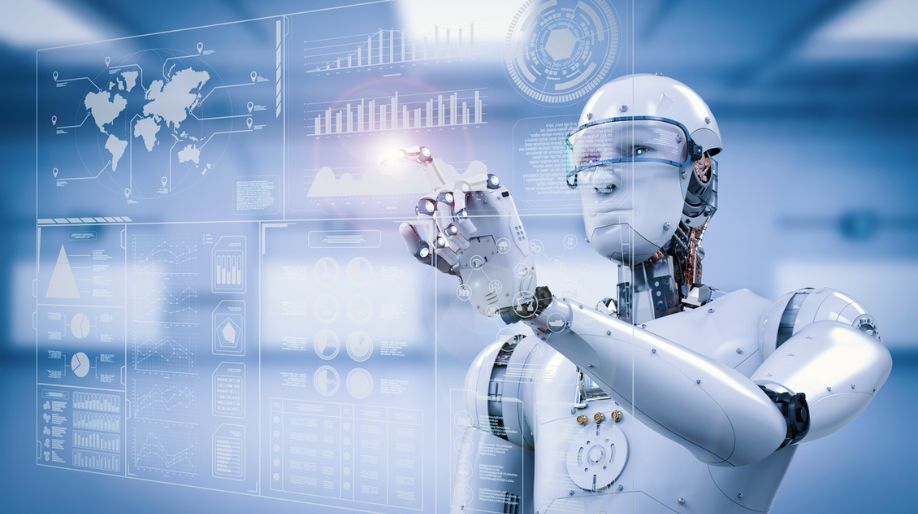
IT has taken over the role of being the support of the present-day society. Digital technologies are influencing all areas, including communication and education, healthcare, and business. The introduction of new technologies based on artificial intelligence (AI), robotics and digital systems is rapidly changing the lifestyle and working conditions.
IT Gadgets and High-Tech Devices
The latest IT devices are also strong electronic gadgets that are programmed to handle, store and transmit information effectively.
Examples include:
- Desktops and laptops of high performance.
- AI-powered smartphones.
- Smart bands are examples of wearable technology.
- Smart home devices
- Control systems in industries.
These devices also have superior processors, cloud computing and other fast-speed internet, which are used to do sophisticated work.
Use and Digital Ecosystems
Apps (or applications) are specific software applications aimed at performing a certain function. The apps have become a larger digital ecosystem today, which is linked to cloud services.
They are used in:
- Internet education and e-classrooms.
- E-commerce platform
- Financial technology and digital banking.
- Programming and data analysis.
- Teamwork and interaction software.
Artificial intelligence is used in many contemporary applications to provide personalised services and to automate them.
Digital Transformation and Computerisation
Computerisation is the transformation of manual systems into computer-based systems. This has changed over the years to become more of a digital transformation, whereby whole industries have embraced new forms of high-level digital technologies.
It is visible in:
- Automated banking systems
- Hospital electronic health records
- Smart governance systems
- e-supply chain management
- There are online reservation and ticketing systems
Computerisation leads to efficiency, low cost of operation and a high level of accuracy.
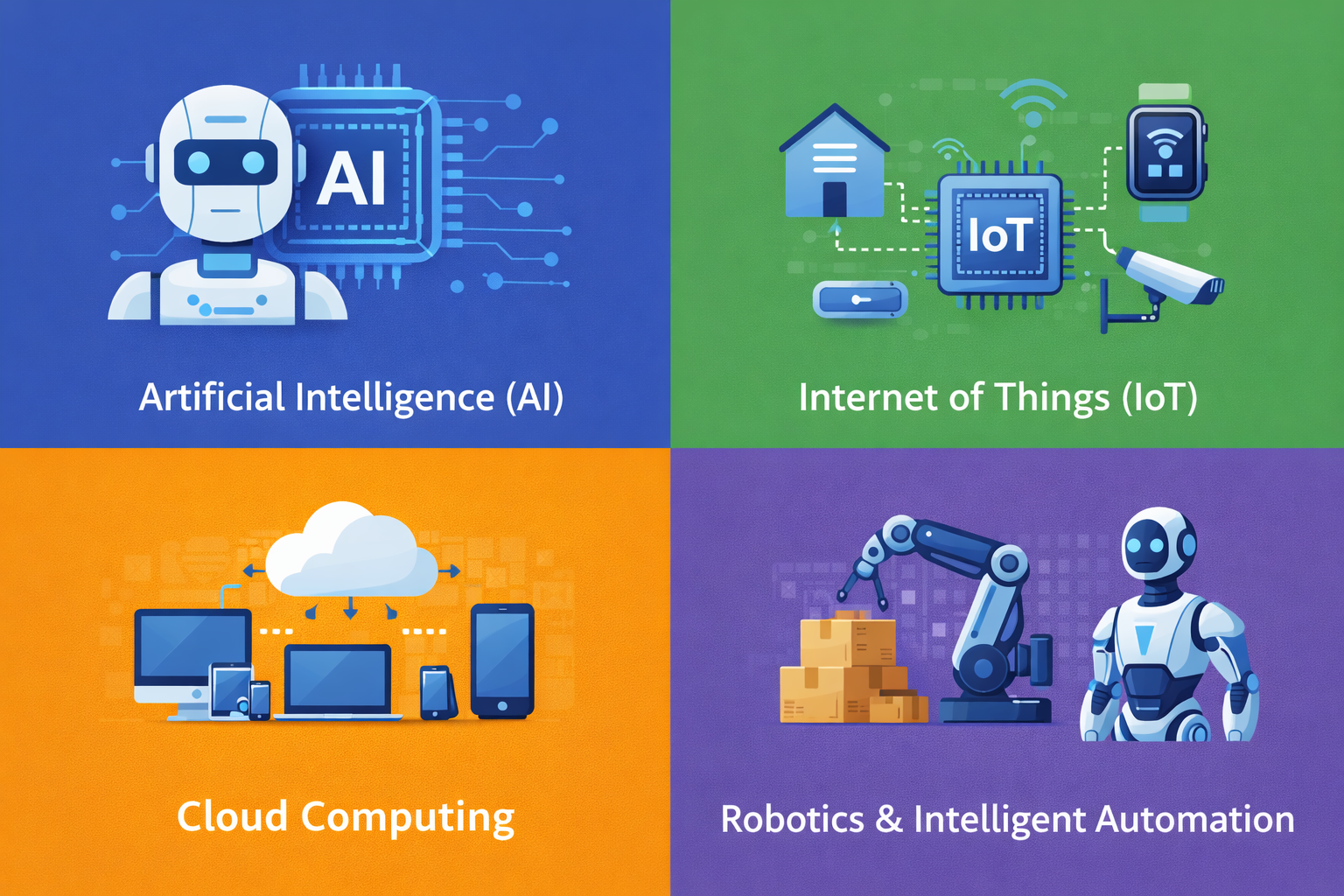
Artificial Intelligence (AI)
Artificial intelligence allows machines to imitate the human mind in the form of thinking, learning and decision-making.
AI technologies include:
- Machine Learning (ML)
- Natural Language Processing (NLP).
- Image and speech recognition.
- Predictive analytics
The fields of application of AI include:
- Healthcare diagnostics
- Financial fraud detection
- Autonomous vehicles
- Personalised recommendations
- Cybersecurity systems
During the processes of continuous learning, AI systems are continuously improving.
Robotics and Intelligent Automation
Robotics is a convergence of both hardware and software and is used to create machines that can accomplish tasks on their own or in a semi-autonomous way.
Robotics has been applied in the following:
- Industrial automation.
- Healthcare surgical robots.
- Space exploration missions
- Operation disaster management.
- Warehouse and logistics management.
Robotics enhances productivity, safety and accuracy in different industries.
Emerging Technologies in IT
Innovations in IT have been occurring at a high rate and include the following:
- Distributed systems, cloud computing
- Internet of Things (IoT)
- Blockchain technology
- Cybersecurity frameworks
- Virtual Reality (VR) and Augmented Reality (AR)
- Big Data analytics
These technologies improve the interconnectedness of the world, data management and security.
Impact of IT on Society
Information technology has an impact on the following:
- Economic development
- International communication channels
- Educational accessibility
- Research and innovation
- Technology career opportunities
With the growth of digital systems, cybersafety and ethical use of digital systems become more important.
QUIZ FOR LATEST DEVELOPMENTS IN THE FIELD OF IT
1. The primary concerns of information technology (IT) include the following:
A) Production of hardware alone.
B) Processing, storing and sharing of digital information.
C) Designing buildings
D) Operation of electricity networks.
Answer: B) Processing, storing and sharing of digital information.
2. Which of the following are examples of wearable technology?
A) Desktop computer
B) Smart band
C) Printer
D) Router
Answer: B) Smart band
3. The primary uses of apps are to:
A) Replace operating systems
B) Do certain work on behalf of the users.
C) Direct computer hardware control.
D) Manage network cables
Answer: B) Do certain work on behalf of the users.
4. The transfer of manual systems to computer-based systems is referred to as the following:
A) Automation
B) Computerisation
C) Programming
D) Networking
Answer: B) Computerisation
5. The principal capabilities that machines have made possible through artificial intelligence are the following:
A) Store unlimited data
B) Reflect, acquire knowledge and reason as humans.
C) Delete all the software programs.
D) Increase internet speed
Answer: B) Reflect, acquire knowledge and reason as humans.
6. What AI solution can computers use to understand and interpret human language?
A) Machine Learning
B) Natural Language Processing.
C) Blockchain
D) Robotics
Answer: B) Natural Language Processing.
7. The manufacturing industries that utilise robots to manufacture products automatically show the following:
A) Virtual Reality
B) Intelligent automation
C) Cloud networking
D) Cybersecurity
Answer: B) Intelligent automation.
8. What is the new technology that links the physical objects like smart appliances to the internet?
A) Blockchain
B) Internet of Things (IoT)
C) Big Data
D) Robotics
Answer: B) Internet of things (IoT).
9. The technology of providing users with digital environments that are immersive is termed:
A) Cloud Computing
B) Virtual Reality
C) Data Mining
D) Cybersecurity
Answer: B) Virtual Reality
10. What do you consider to be one of the biggest social effects of IT development?
A) Reduced communication
B) Low access to education.
C) better innovation and communication worldwide.
D) Destruction of electronic gadgets.
Answer: C) Better international communication and innovation.